News
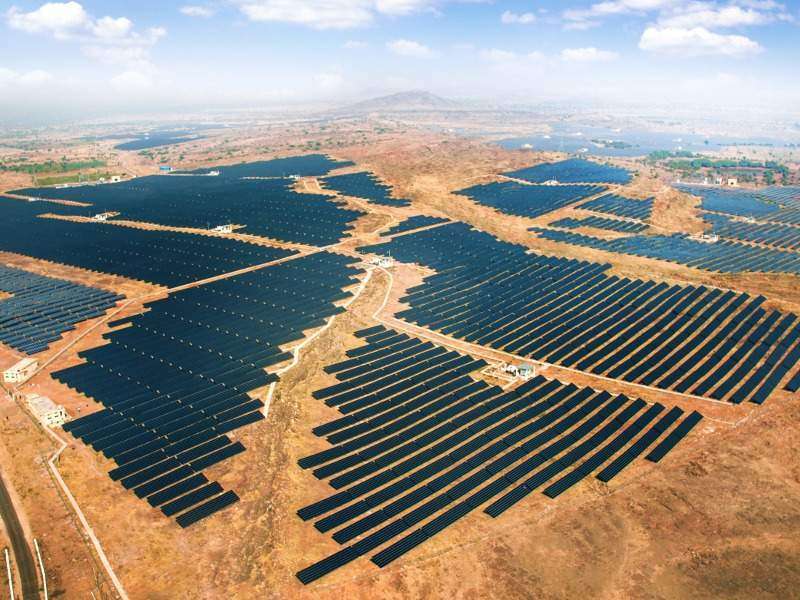
Bhadla Solar Park
02 January 2024 | Research
It's a point that India's prime minister, Narendra Modi, raised at the 2021 COP26 summit in Glasgow, Scotland. Modi pledged that India would hit net zero by 2070 — two decades ahead of many Western countries, and a decade later than China. At last week's COP27 in Sharm El-Sheikh, Egypt, India affirmed that deadline.
The project commenced in 2015 with an investment of $1.4 billion. The largest solar farm in the world is located in Rajasthan, in the country's northeast. The temperature in Bhadla ranges from 46 to 48 degrees and it is defined as uninhabitable by experts. Since construction began, Bhadla Solar Park has slowly grown to cover an enormous 5,700-hectare desert site with solar panels. And today it generates enough electricity to power 4.5 million homes.

The entire project was divided into four phases. In the first phase of the park's establishment, solar panels were established to produce 65 MW of energy. The first two phases of the park were developed by the Rajasthan Solar Power Park Company Limited. Saurya Urja Company of Rajasthan developed the third installment. The project in its final stage was designed by Adani renewable energy park. The capacity of the project was 500 MW.

Because the park was built in four phases, with each field of solar panels larger than the last. The buildout happened so quickly thanks to the involvement of the Climate Investment Fund — alongside more general multilateral development banks — which was set up by the G8 countries specifically to cofinance climate-mitigation projects.
With $200 million initial funds, they were able to mobilize $112 million in additional co-financing on this project, which has resulted in 5.6 million tonnes of CO2 reduced, and it has put 2.7 gigawatts of installed capacity on the ground.

There is another important lesson from Bhadla that underscores how massive projects require careful logistical planning. Phase one had a number of weaknesses, which included the private-sector guys being ready with their panels, having taken loans, paying interest on those loans, and their power having nowhere to go because the evacuation arrangements weren't ready.
"Evacuation" is an energy-industry term of art describing how generational projects need to be connected to a wider grid. And in India, this meant navigating the complex bureaucracy and politics of both the nationwide and regional electric grids.
Reference :
O'Malley, J. (2022, November 23). India is harnessing renewable energy through the world's biggest solar farm. here's how it happened. Retrieved March 20, 2023, from https://www.businessinsider.com/india-harnessing-renewable-energy-through-worlds-biggest-solar-farm-2022-11
Popular Post

Payment of Tuition Fees (UKT) for Even Semester 2023/2024 at ITS : Don't Miss the Deadline!
Academic
25 January 2024